|
WE'RE IN THE MAY ISSUE OF SOJOURNERS MAGAZINE! Sojourners is the oldest and largest magazine in the nation catering to Christian progressives. A few months ago they reached out to us with a proposal for a promotional partnership. The first result of the partnership is a full-page ad in their May, 2024 issue featuring The Christian Left! We couldn't be more excited about it!  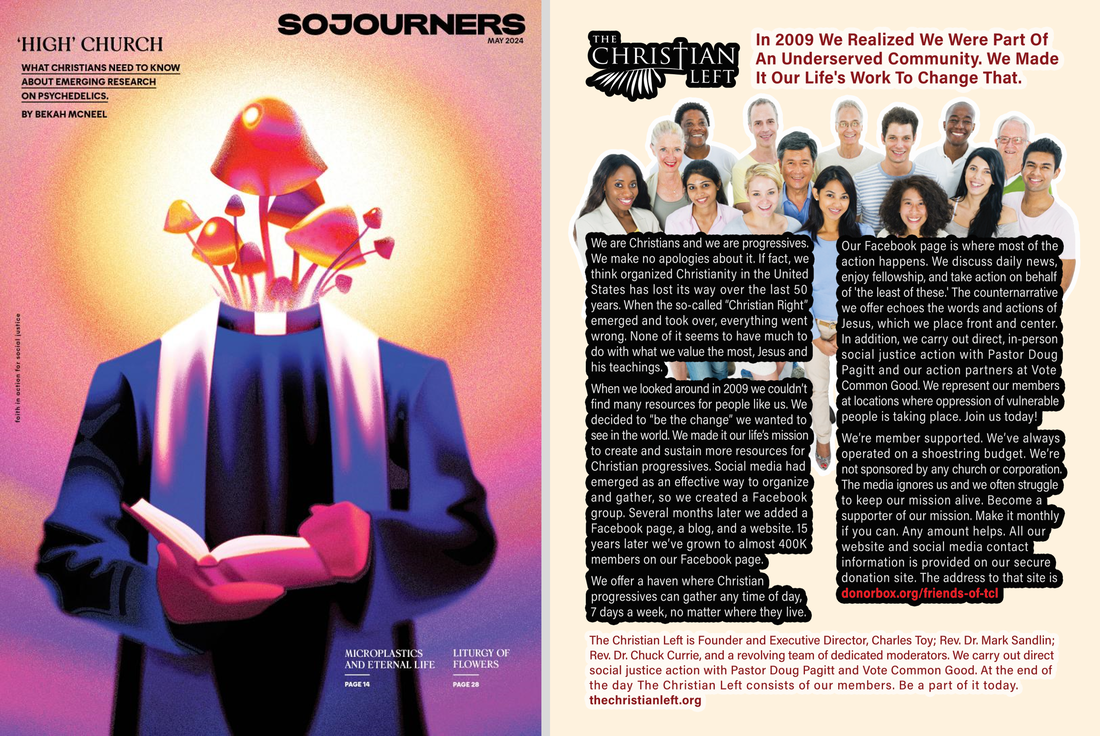 Here's the full-page ad from page 38 of the magazine. 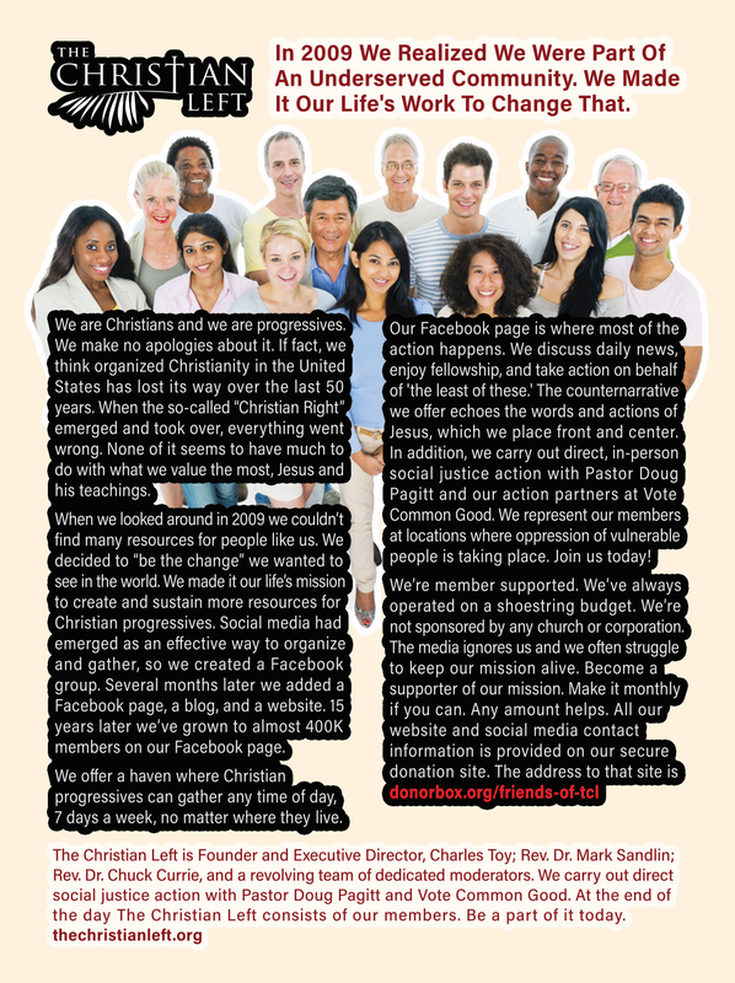 Stay tuned for more exciting news about our promotional partnership! Final Message: The reason we went all in with Sojourners is that we've been at this for 15 years now, and 2024 is the most important year of our existence and mission. Anyone who considers themselves a Christian and a progressive knows why. We are literally facing a struggle to keep our nation from being something very different than it has been up to now. It's our time to step up. It's yours too. Please help us do everything we can possibly do in 2024 and beyond to sustain our mission, our ministry, the Christian Left community, and our Democracy as we know it. (Secure Site. Never any problems in 15 years.)  Link To Copy & Paste If Necessary: https://donorbox.org/friends-of-tcl We're used to it, but here's what we're up against in terms of messaging budgets. Every little bit helps: 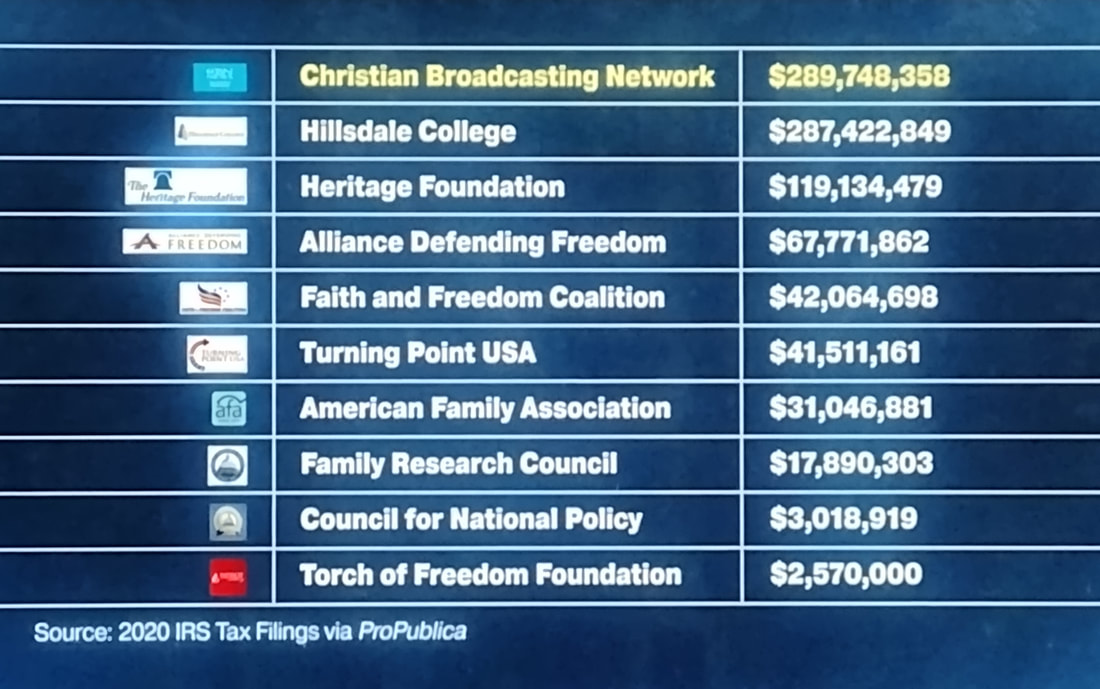  Screen capture above from the film "God + Country." * Images included fall under the “Fair Use” exemptions of the US Copyright Law. We give this film our highest recommendation. We hope as many people as possible watch it before the 2024 election. -- The Christian Left P.S.: We have a bunch of really cool 'merch' we've designed with you in mind. We have over 100 designs in our store for Christian progressives and their allies!  Don't take our word about Charlie Kirk. Read all about his litany of lies here. Charlie is a fake "Christian" of the most dangerous variety. He travels around to churches and brainwashes the members with lies that have absolutely nothing to do with anything Jesus said or did. Charlie says you can't be a Christian and vote for a Democrat. Here he is in action. Go to 51:47 in the video: Charlie is against most of what Jesus taught, therefore he is against Jesus. He is to be avoided like the disease he is. Pray for his soul, but avoid him. 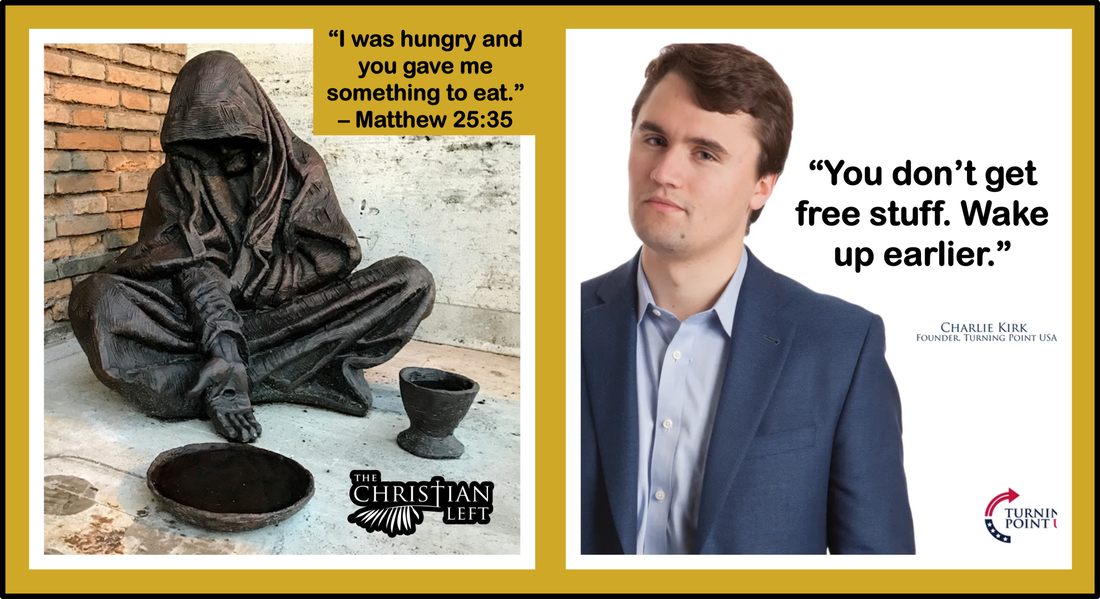 Like most fake "Christians" Charlie likes to harp, and harp, and harp about things Jesus either never talked about, or spoke about but Charlie and the gang don't get: Abortion and Homosexuality. Meanwhile Charlie ignores the bulk of the main topics Jesus spoke about.
Typical. Neither of Charlie's fav' topics are settled Theology, not even by a long shot. (See more on this here, and here). The main points Jesus made over and over ARE settled Theology. Charlie ignores them. A fundraiser was started on our behalf by our action partners at Vote Common Good in late 2022. We appreciate everyone who has contributed to the fund! Contributions to the goal amount passed the halfway mark in June. Can you help us chip away at this goal so we can wrap up the fundraiser and resume our normal activities? We don't have outside funding other than you. We're not sponsored by any church or corporation. We've always been grassroots and we've always operated on a shoestring budget. The link just below will take you to the fund. You can also click on the graphic below. Thanks so much. Please help us dig out of this hole once and for all. 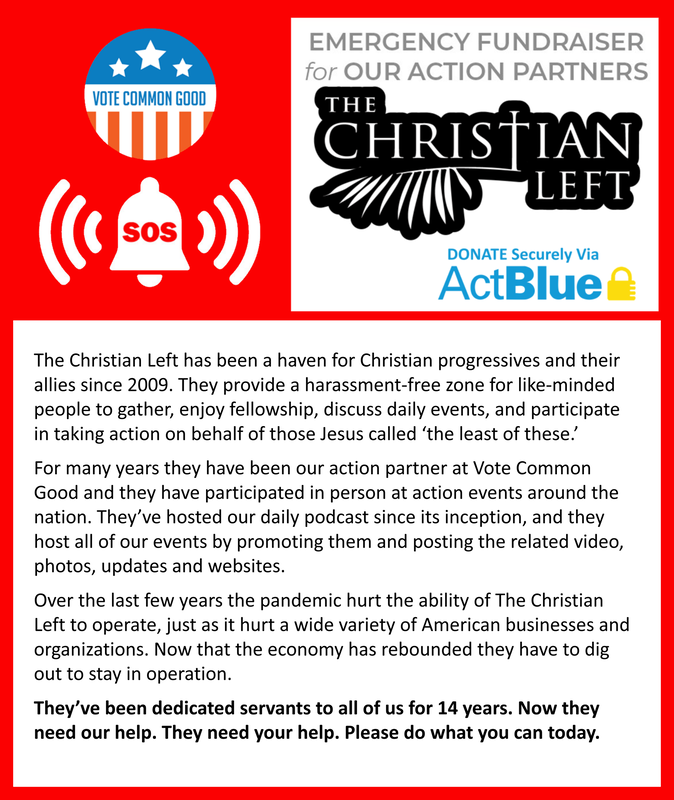 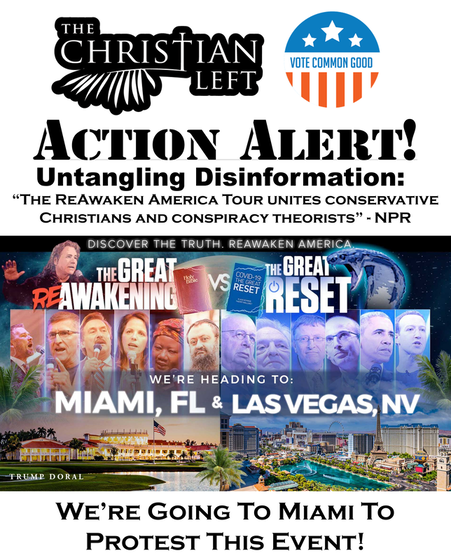 The Christian Left and Vote Common Good firmly believe in the value of faith in action. That’s why we’re headed to Miami to join a counter-protest outside of Trump’s golf resort at Doral, the next stop on the Christian Nationalist “Reawaken America” tour.
This tour is a series of rallies organized by a far right, Christian Nationalist “news” organization called Charisma News. These events feature all the most extreme right-wing media personalities: General Michael Flynn, Roger Stone, Eric Trump, the My Pillow Guy, and dozens more. Their goal is to spread Christian Nationalist propaganda to disillusioned voters whose communities have fallen into neglect. They stoke hate and division and use it to drive evangelical voters into the arms of an increasingly radical Republican party. We’re going to stop them. Here's a link to an NPR article about the activities of “Reawaken America.” Last Summer, with your support, we joined in an interfaith counter-protest at their event outside Batavia, NY. Now they’re headed to one of Trump’s resorts in Miami, and our team is going to be on the ground again to clearly counter their message of hate. The Christian Left and Vote Common Good are working with other groups in staging a counter-protest at this event to spread our message of unity, love, justice, and the greater good because this radicalized agenda has to be directly challenged by people of faith. It’s going to cost about $5,000 for our action team to make this trip. Can you pitch in now to help cover the cost of our travel expenses? We will also be livestreaming our counter-protest so you can follow along at home. But if you’re in the Miami area and want to join us, contact us at [email protected] ! As pastors, organizers, and faith leaders, we know it is crucial for faith-based voters to see people from their own faith community take a stand against the dangerous rhetoric of Christian Nationalism. This not only has an impact on the people who attend the rally in person, but on every person of faith who will see the coverage online and in the media. We know direct action is effective. That’s why it’s so important our team goes to Miami to counter the narrative of these dangerous radicals. Help us get to Miami to bear witness to the true values of our faith and challenge people to abandon Christian Nationalism. If we can raise $5,000 today, the entire trip’s expenses will be covered up front. Taking action requires financial sponsors. Please do what you can. If you've saved your payment information with ActBlue Express, your secure donation will go through immediately. Here's the link to donate: Thank you for making our work possible. We couldn’t do it without you. In this together, The Christian Left & Vote Common Good  "I’m a proud Christian Nationalist" - Marjorie Taylor Greene Marjorie Taylor Greene has started peddling absurd garb online proclaiming her pride in idolatry (for $30 per shirt no less). "Christian Nationalism" isn't Christian by any stretch of the imagination. It's idolatry. In no uncertain terms it is the greatest threat to democracy in America today. 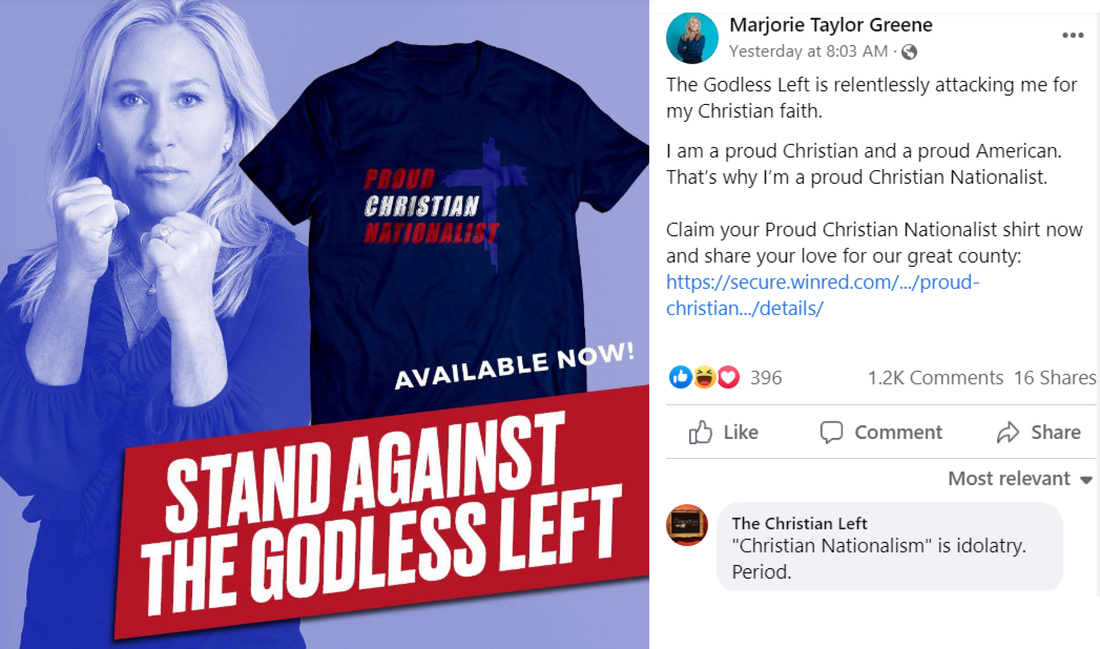 Click Here To Leave A Comment On Her Embarrassing Post Update: Not long after we posted this blog article she took this post down on Facebook. Greene started peddling this garbage the same day an article appeared in Newsweek highlighting a Tweet made by our own Rev. Dr. Chuck Currie calling her out for asserting her "Christian" Nationalism. Rev. Currie has been a member of our admin team since 2010.
The sad fact is that modern Republican ideology as a whole is antithetical to everything Jesus taught. Party tenets mock everything Jesus ever said, especially about 'the least of these.' For a long time now we've been highlighting the fact that Christians cannot serve God and the Republican party. We've been sounding the alarm since 2009. Sometimes if feels hopeless. "Christian" Nationalists like Greene keep getting louder and more bold. They claim the opposite of the truth, that we are the ones attacking them! They assign labels to us like "the Godless Left." Isn't it strange that when you advocate for 'the least of these' as it relates to public policy all of the sudden you are "Godless" to people like Marjorie Taylor Greene? It's never made much sense to us. The only explanation is that evil parades itself as truth. The 'father of lies' calls the truth false and lies the truth. Thankfully, nothing is impossible for God. All we can do is speak the truth each day and give the outcome of our effort to God. The fact that our number of social media followers on this page alone has increased to 376K is a good sign. We just keep showing up each day and speaking out against the words and behavior of people like Marjorie Taylor Greene. Please read all the articles linked in this post. They are all very enlightening with regard to this topic. -- The Christian Left 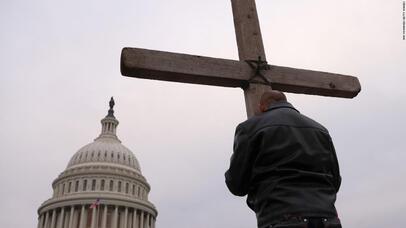 We have been sounding the alarm about this situation for 13 years. It is one of the main reasons we started this ministry. One of the other big reasons was to give people a place to gather who saw the same thing we did. As many of you know, if you bring this up just about anywhere you will likely be verbally attacked. We needed a haven in a big way.
This situation didn't pop up out of nowhere. It's been brewing ever since Paul Weyrich and the boys cooked up The "Christian" Right back in the mid to late 70's. The boat we now find ourselves in was inevitable. A figure like Donald Trump was inevitable. Now we face a situation where it could be the demise of our nation. There's a very real chance America could fall over this and become something entirely different. These people don't care what it takes in order to force their will on the rest of us. They've proved that over and over. For all of the above reasons we decided this was an article we needed to preserve on our blog. We'll post the first couple of paragraphs here and link to the rest. This is knowledge everyone who follows The Christian Left needs to have. An 'Imposter Christianity' Is Threatening American Democracy (CNN, 07-25-2022) Three men, eyes closed and heads bowed, pray before a rough-hewn wooden cross. Another man wraps his arms around a massive Bible pressed against his chest like a shield. All throughout the crowd, people wave "Jesus Saves" banners and pump their fists toward the sky. At first glance, these snapshots look like scenes from an outdoor church rally. But this event wasn't a revival; it was what some call a Christian revolt. These were photos of people who stormed the US Capitol on January 6, 2021, during an attempt to overturn the results of the 2020 presidential election. Link To The Rest Of The Article Final Note: Most of us realize we should have begun taking action to counter the activities of The "Christian" Right long ago. We should have taken more of a stand right from the beginning. That said there's nothing we can do about the past. All we do is 'be better' moving forward. We've been at it for 13 years. One thing has become painfully obvious. You can't do much of anything in the political world without a budget. We have to have your help with that. We're community supported. Make a contribution today. We'll put it to good use with direct action countering the toxic ideology spoken of in the above article. Link To Make Contribution -- The Christian Left 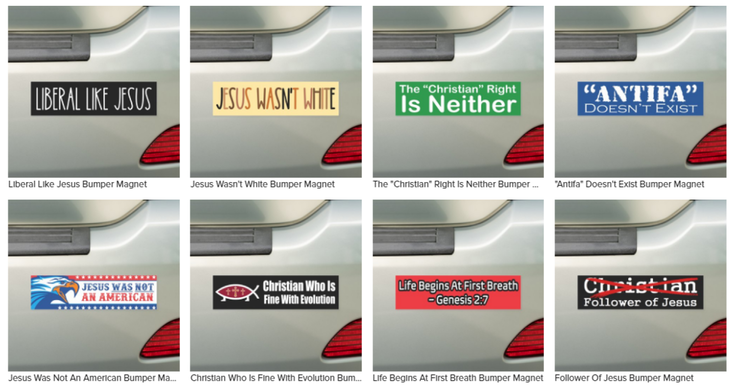 That's right! Your eyes didn't deceive you! All of our popular bumper stickers (61 and counting) are now available as flexible magnets in the 11" X 3" traditional bumper sticker size!
Link to order at bottom of page. Many in the TCL community have been requesting this and we found a solution with Zazzle.com, a company that manufactures the magnets with our designs. We've worked with Zazzle before. The way they handle shipping is a little different but it has improved. Based on feedback from TCL members one has to create a username and password to order. This is not unlike many sites and makes it easier to track your order and interact with them if something goes wrong. Important Note On Shipping The Magnets From Zazzle Hands down the best way to do shipping with Zazzle is to sign up for 'Zazzle Black.' Otherwise the cost of shipping is fairly high per item. The good news is they've made it much less expensive than it used to be. Now Zazzle Black is just $9.95 per year for unlimited standard shipping. It sounds too good to be true. That's not $9.95 per month, but $9.95 for a full year of free standard shipping. We highly recommend it. Click Here To Go To Zazzle Black Page All our stickers are still available. If you like the look of bumper stickers, but you're not ready for a permanent solution, car magnets are the perfect product. All the personality, none of the commitment! - Dimensions: 11" x 3" - Vivid full-color digital printing - 30mm magnetic material - Easy to apply, remove, and re-apply - Coated for superior UV protection All the new Bumper Magnets are in our Zazzle store. As of today we have 61 designs. Click Here To Order Your Magnets From Our Zazzle Store -- The Christian Left Some Examples Of Our Bumper Stickers Below (Link To New Storefront At Bottom Of This Post) 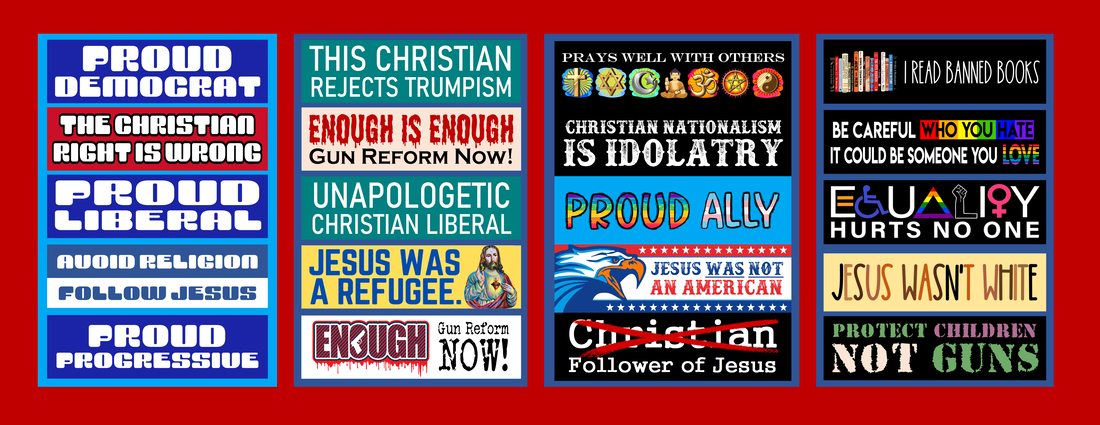 We've moved our bumper stickers to a new storefront. We currently have 57 stickers and counting. They were very popular on Etsy but we didn't like having a big 'middleman.' We're sure they'll be just as popular on our new storefront because they are designed with you in mind. Each sticker measures 3" x 11.5". We don't have the ability to make car magnets at this time but Amazon offers a really cool workaround. It's a flexible magnetic strip cut the same size as our stickers. See directly below. 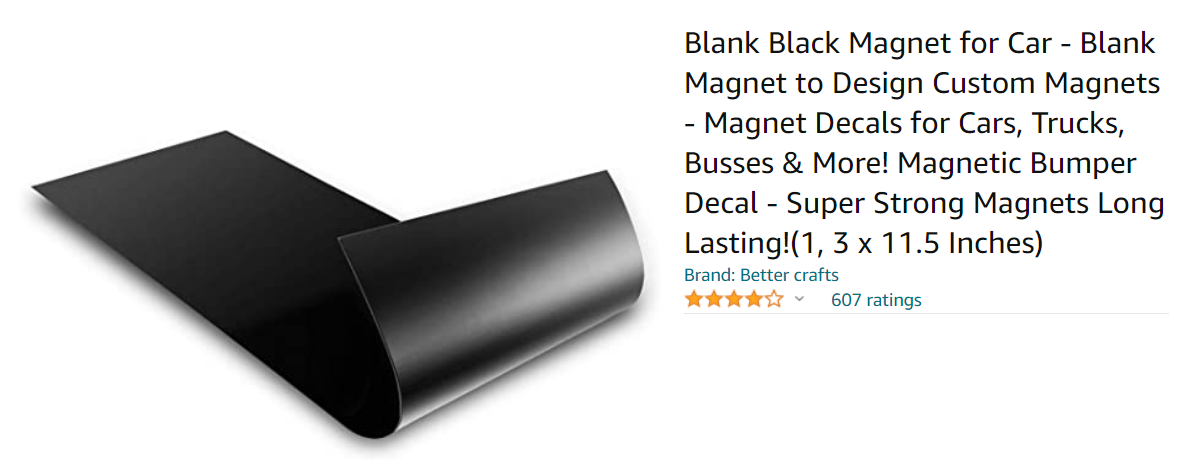 We just put up our new storefront so if you have any problems please report them in comments on our Facebook page. It should work fine but you never know until orders start coming through.
As you look over the various stickers, when you reach the bottom of the page you will have to click "Load More" to keep viewing more. You've reached the end when it no longer offers the "Load More" link at the bottom. There is no need to "Log In." That option is for website administration. THERE IS NO NEED TO SELECT SIZE, SHAPE, OR SURFACE ON THE STICKERS. THEY ARE DEFAULT VALUES. Click Here To Go To Our New Storefront If you have any requests for stickers please let us know in comments on the social media pages. -- The Christian Left  You are going to see and hear a handful of scriptures over and over again in the coming years as we engage in the battle to restore women from 2nd class citizenship. The "Christian" Right throws them around all the time. They've cherry-picked a few scriptures and twisted them to mean something they don't. Let's look at some of those scriptures. The first such passage is found in Psalm 139:13-16: "For Thou didst form my inward parts; thou didst weave me together in my mother's womb. I praise thee, for thou art fearful and wonderful. Wonderful are thy works! Thou knowest me right well; my frame was not hidden from thee, when I was being made in secret, intricately wrought in the depths of the earth. Thy eyes beheld my unformed substance; in thy book were written, every one of them, the days that were formed for me, when as yet there was none of them." All this passage states is that God is directly involved in the creation of a fetus and knows its future. This is useless for the anti-choice position, since God creates all living things, including trees and bugs. Plus, just because God is supposedly omniscient doesn't give fetuses any special status—it simply means God already knows whether they will live or die. It is dishonest to conclude from this verse that a fetus is a human being deserving of more protection than women. The passage is poetic prose that anti-choicers have twisted and trivialized by giving it a literal, objective meaning where there is none. The second passage used by anti-choicers is similar: "Now the word of the Lord came to me, saying, 'Before I formed you in the womb I knew you, and before you were born, I consecrated you'..." (Jeremiah 1:4-5) Unfortunately, anti-choicers usually stop right there, and forget the rest of Verse 5, which negates their preferred meaning: "...'and I appointed you a prophet to the nations.'" This passage is specific to one, very special person—Jeremiah the prophet, whom God has called to provide miraculous powers and authority to the world. Since we are not all destined to be divine prophets, this verse cannot be construed as applying to any fetus except the unborn Jeremiah. Again, anti-choicers are being dishonest by pulling this verse totally out of its context. The third passage quoted by anti-choicers tells the story of Elizabeth, the mother of John the Baptist, and Mary the mother of Jesus, while both were pregnant: "In those days, Mary arose and went with haste into the hill country, to a city of Judah, and she entered the house of Zechariah and greeted Elizabeth. And when Elizabeth heard the greeting of Mary, the babe leaped in her womb, and Elizabeth was filled with the Holy Spirit." (Luke 1:39-41) This passage simply records a fetus kicking in the womb. We can only wonder in befuddlement why anti-choicers think this would help them. Besides, John the Baptist is yet another divine fetal prophet ordained by God. Since very few of us are chosen by God before birth to herald the arrival of the Messiah on earth, we cannot claim that this passage venerates all fetuses. Scripture analysis below from "The Bible is Pro-Choice," by Joyce Arthur.  We've been on the front lines of the struggle to take back the definition of our faith from what we classify as a cult since 2009. Right-wing ideology mixed with the Christian faith is misguided and toxic. Whether its adherents realize it or not, they are practicing Objectivism. Their ideology is no different from the 'law of the jungle,' where the strongest and smartest get their needs met, and the poorest, the weakest, and the sickest get what they deserve, which is nothing. On top of that they target and abuse groups that were already oppressed to begin with.
They have all kinds of rationalizations to avoid cognitive dissonance. One of the favorite is, "It's not the government's job to take care of these people. That's the job of the church." The Bible doesn't support this notion in any way. In fact scripture is full of instances where God became very angry when leaders, nations, and citizens ignored their responsibility. "Now this was the sin of your sister Sodom: She and her daughters were arrogant, overfed and unconcerned; they did not help the poor and needy." Ezekiel 16:49 We need you to participate in our effort financially. With the overturning of Roe the need has become dire. We participate in direct action. We go to hot-spots around the nation to let people know there are Christians who don't act like those who claim to represent us on the right. We partner with 'Vote Common Good' for a variety of direct action activities as well. It really is time for everyone to invest in what they care about. It doesn't do any good to sit back and get angry without doing anything. This is what we do. We will represent you on the front lines. We already do. Here's a link to make a contribution: https://donorbox.org/friends-of-tcl 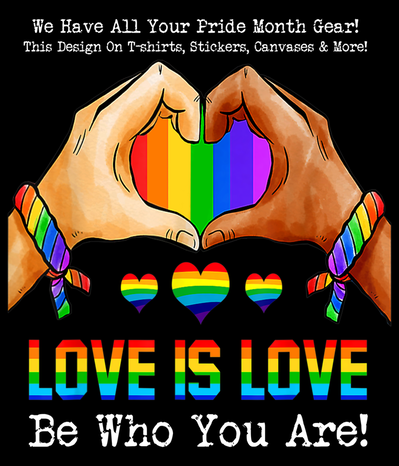 Trolls have been out hot and heavy trolling us about anything we post related to 'Pride Month.' Their favorite thing to do is post a bunch of scriptures about 'pride' in comments. As usual, they miss the point entirely. LBBTQA+ people have been bullied, beat up, burned in ovens (Hitler), put in camps (Hitler and others), and discriminated against in every conceivable way since the beginning of time. It's a very recent phenomena in the US that they've gained any measure of equality and acceptance. Jesus himself admonished us as his followers that we are to 'Love God and love our neighbors as we do ourselves.' No exceptions. This being the case he gave us permission to 'love ourselves.' Loving ourselves in a healthy way is a good thing. If people hate themselves they will treat others poorly. That's just a fact. Scriptures that point out pride being a bad thing do not refer to pride that comes from loving God, loving our neighbors, and loving ourselves. There is good and bad pride. Pride as it relates to 'Pride Month' is a good pride. It's the kind of pride that says 'I accept myself and I love myself the way God created me to be.' Further, 'I accept and love you as my neighbor because I am able to accept and love myself.' It's a healthy thing all the way around. It's win/win/win in the God-Self-Neighbor relationship. Now, here's the kicker for the trolls who troll us over this. The pride they are acting out by lecturing us about Pride Month is the bad kind of pride God warns us about. They feel they need to come to a page they obviously don't relate to and lecture us and judge us with scriptures they don't understand. THAT is pride being a sin, but they will never accept that coming from us. They're blinded by pride and self-righteousness. We pray for the Holy Spirit to open their eyes one day. We don't bother telling them here because we know they won't listen. We used to try to reason with right-wing, "Christian" trolls. We were never able to change a single one of their minds. They will literally argue for hundreds of hours and then go get their friends to join in. LGBTQA+ people have every reason to love themselves and express pride in the newfound bit of acceptance they've garnered in modern western society. God made them the way they are. The 'clobber scriptures' in the Bible (like all other scriptures) must be studied from a historical and a contextual perspective. Most of the clobber scriptures were written by Paul for various reasons like warning about temple desecration. The scriptures in the Old Testament were ancient Jewish civil law based on what they perceived as cleanliness. That's why eating shrimp and wearing mixed fibers are lumped in the same scriptures as admonishments about same-sex sexual activity. 'Don't rape your guests' was one of the the issues God had with Sodom. Then there's the scripture many ignore: "Now this was the sin of your sister Sodom: She and her daughters were arrogant, overfed and unconcerned; they did not help the poor and needy." - Ezekiel 16:49. It always comes down to how we treat the poor, needy and oppressed with God. That doesn't fit well with modern Capitalism so folks ignore it and pick on gays, women, immigrants, minorities ... and the poor. A great deal of study has been carried out on this topic by Bible scholars. It's out there. In terms of Jesus himself speaking about marriage law he also mentioned exceptions to the law, namely to 'born eunuchs.' He said that 'some eunuchs were made that way by other people,' AND some were 'born that way from their mother's wombs.' There is a respectable amount of Bible scholarship that says Jesus was referring to LGBTQA+ people. To us it seems obvious. It's worth pointing out that Jesus never said one more word about it. Not one word. To us that speaks volumes. -- The Christian Left |

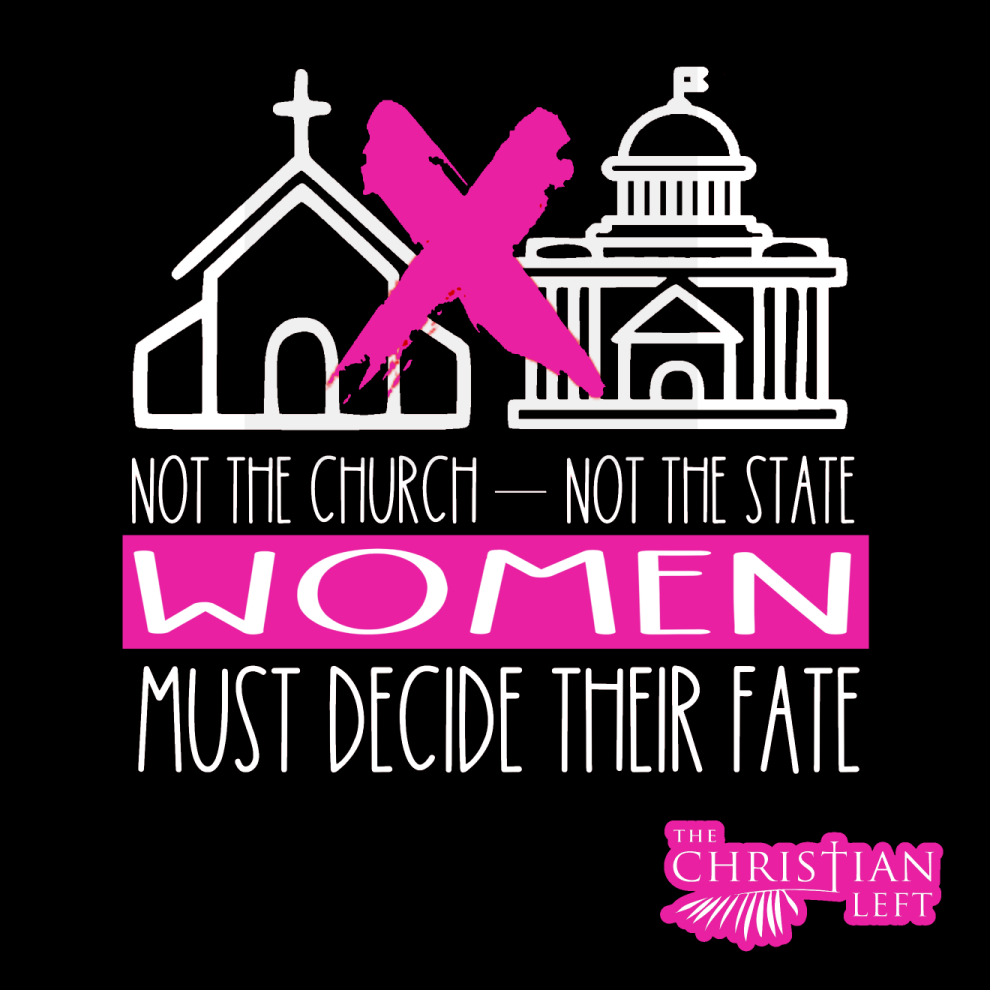
Our Newest Shirts!
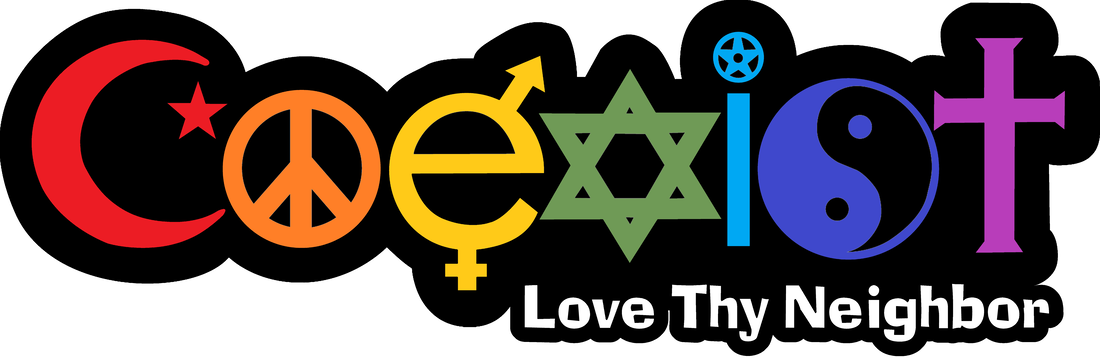
Bumper Sticker

The Christian Left Store
Chalice Press has the best selection of Progressive Christian Books in the world.


Advertisement

About TCL BlogWe’re not about Dogma here. We’re just Christians who think the political and Christian right-wing have their priorities wrong. Featured Bloggers
Charles Toy is the founding member of The Christian Left. We're sure you will enjoy his passion as well as his wit. Guest bloggers featured often.



Archives
April 2024
Categories
All
 |